
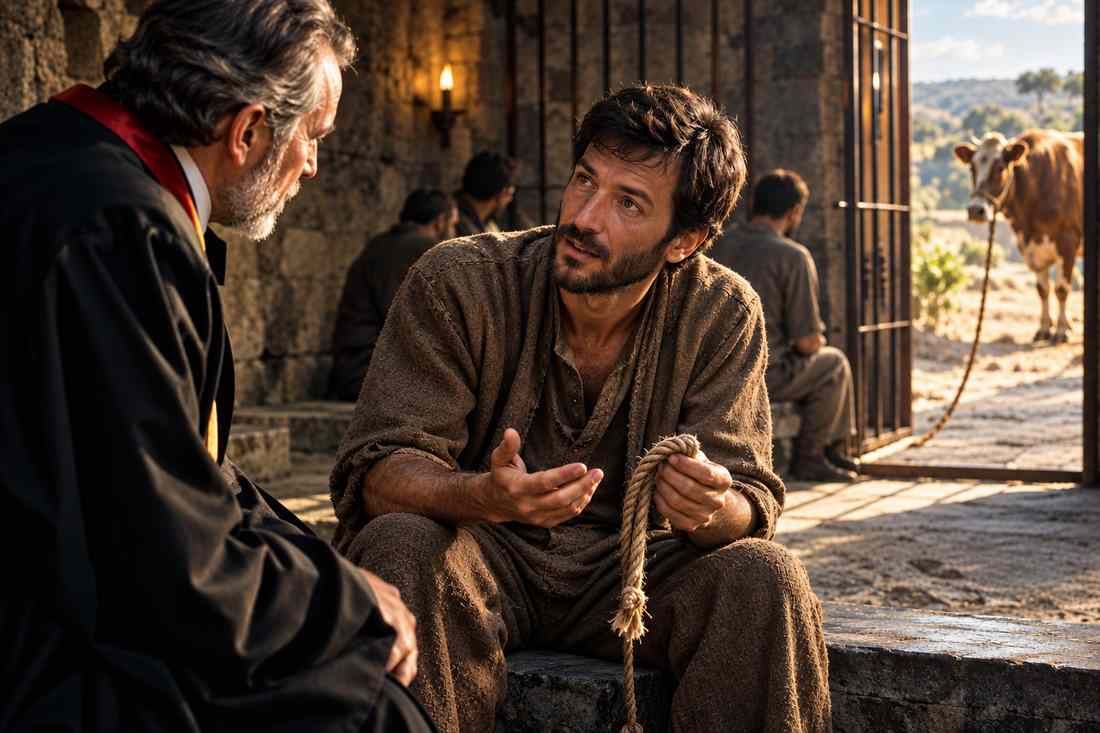
THE COW AT THE END OF THE ROPE
When people talk about their own mistakes, they sometimes get so caught up in the details that they lose sight of the real issue. They focus on a tiny part of what they did and forget to mention the consequences. What they say in their defense may not be false, but it does not necessarily tell the whole story.
We see this in everyday life all the time. Someone breaks a promise but spends a long time explaining why they couldn’t keep it. Someone hurts another person and then says, “I only said something.” A manager emphasizes a minor detail of a decision while avoiding any discussion of how many people were affected by it. Everyone has an explanation of their own. Yet sometimes the whole issue lies in one small detail that has been left out of the story.
An old joke captures this so well that it makes us laugh while also prompting us to take a closer look at ourselves.
One day, a judge visited a prison. As he spoke with the prisoners, he turned to one of them and asked:
“My son, what crime did you commit to end up here?”
The prisoner lowered his head.
“Your Honor, I only stole a short piece of rope!”
The judge was surprised.
“Good heavens! Can a person really be sent to prison for such a tiny piece of rope? What a harsh punishment!”
Encouraged by the judge’s sympathetic reaction, the prisoner continued:
“You’re right, Your Honor! It wasn’t such a serious crime…”
The judge asked curiously:
“Then why are you in prison?”
Without the slightest hesitation, the prisoner replied:
“Your Honor, there was a cow at the other end of the rope!”
The beauty of the joke lies in what the prisoner actually says. He really did steal a piece of rope. His statement is not a lie. But by failing to mention that there was a cow attached to the other end, he completely changes the meaning of the incident. The judge, too, has initially focused on how small the rope was without yet knowing the information that matters most.
Don’t we sometimes behave the same way? When explaining a mistake we have made, we emphasize the part that suits us and conveniently leave out the rest. And we don’t always do this deliberately. When people feel guilty, they may become defensive. Instead of admitting their mistakes, they try to explain them away, make them seem less serious, or even justify them without realizing what they are doing.
Yet the significance of an action cannot be measured simply by how it appears on the surface. A small oversight can disrupt someone else’s work. A thoughtless remark can damage a friendship that has lasted for years. A decision we consider unimportant can have unexpected consequences for other people’s lives. The rope itself may be small, but we cannot understand the true scale of the incident without knowing what is attached to its other end.
This also gives us something to think about when it comes to honesty. Being honest does not simply mean avoiding outright lies. Sometimes, we can mislead others even while telling the truth. When we describe only the part of an incident that works to our advantage and conceal the rest, we leave the truth incomplete, even if everything we say is factually correct.
For example, someone might say, “I didn’t insult them. I was just telling the truth.” Perhaps there really was some truth in what they said. But if they leave out the circumstances, the tone of their voice, and the purpose behind their words, we cannot fully understand why the other person was hurt. Telling part of the truth can be very different from telling the whole truth.
There is also the question of responsibility. Explaining our mistakes is perfectly natural. Not every mistake comes from the same intention. People can misunderstand things, make errors in judgment, or act without thinking. But having no bad intentions does not erase the consequences of our actions. If we have hurt someone, we must acknowledge it, apologize when necessary, and make an effort to repair the damage. Saying, “I didn’t mean for that to happen,” is not always enough.
The judge’s behavior in the joke offers another lesson. After hearing the prisoner’s first statement, he was quick to reach a conclusion. He assumed that the man had received a harsh sentence for stealing a small piece of rope. But he did not know the whole story. We sometimes make the same mistake when listening to others. We get carried away by the first words we hear, listen to only one side of an argument, read nothing more than a news headline, or judge someone based on what another person has told us. Then, when new information comes to light, we have to reconsider our conclusions.
For this reason, fairness is not simply about criticizing those who do wrong. It also requires us to understand what actually happened, fill in the gaps in our knowledge, and exercise sound judgment before reaching a decision. Just as it is important to understand the true extent of an offense, the punishment must also be proportionate to the wrongdoing. We need to see the cow at the end of the rope, but discovering that the cow was there does not automatically answer every question about justice.
I believe the real strength of this joke lies in its invitation to examine our own behavior before judging the mistakes of others. We can easily recognize how other people defend themselves. But when it comes to our own defenses, we may find it much harder to remain equally impartial.