
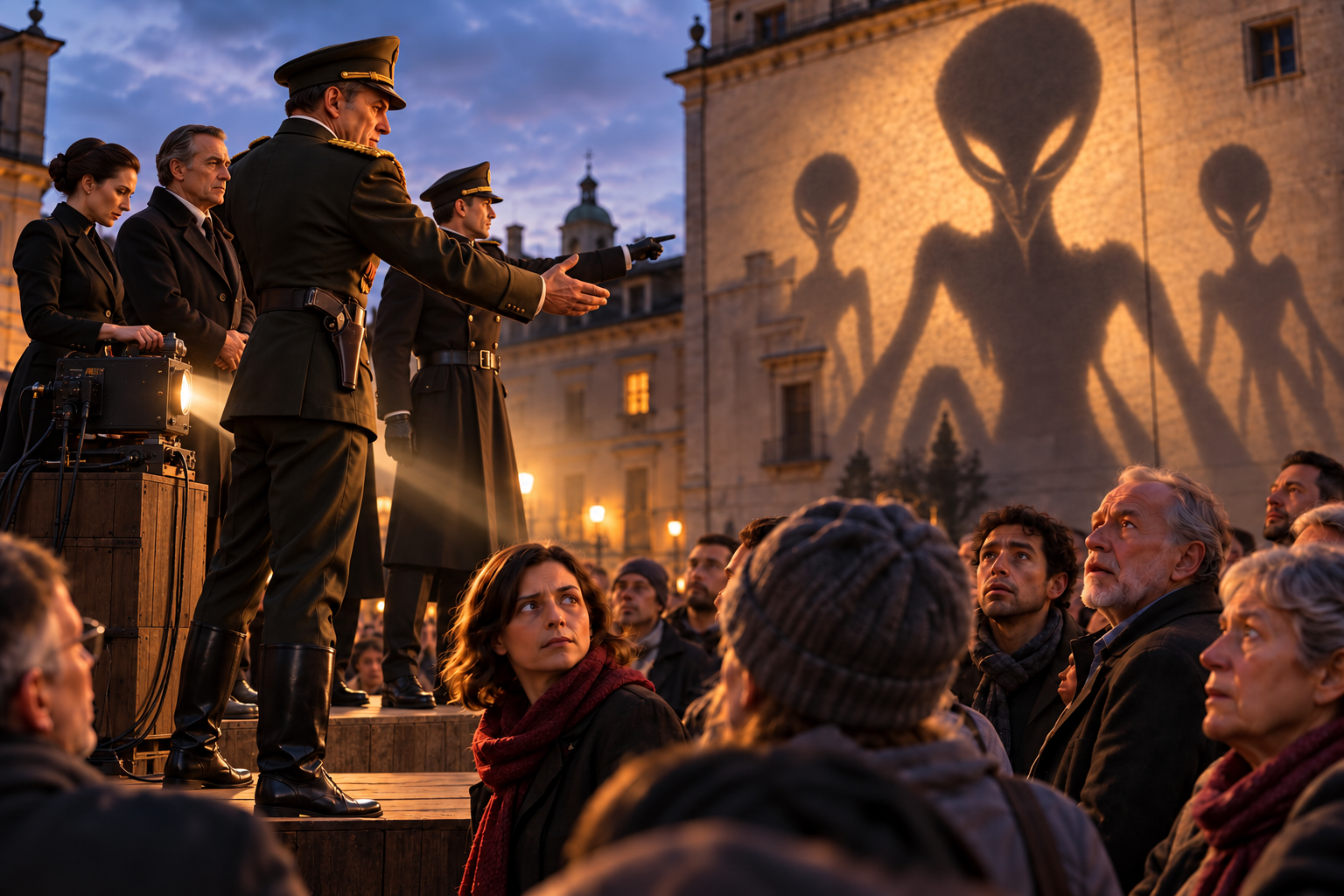
THEY CREATE THE FEAR, THEN OFFER PROTECTION
One of the oldest ways of controlling people is to give them an enemy to fear. A frightened person thinks about security before freedom. When people feel threatened, they are more likely to grasp the hand extended to them than to question it. That is precisely when someone steps forward and says:
“Don’t worry. We will protect you.”
First, the fear is magnified. Then the savior appears.
This idea, attributed to Noam Chomsky, points to a very old mechanism of politics:
“Unite society around a threat, then present yourself as its protector against that threat.”
The enemy does not always have to be real.
A real threat can be exaggerated. A distant danger can be kept constantly in the public eye. People who think differently can be labeled as “the other.” Eventually, society becomes more concerned with choosing sides than with discussing the truth:
“Are you with us or with them?”
Once this question becomes the center of politics, the actual performance of those in power can easily be pushed into the background. The state of the economy, problems in education, the functioning of justice, merit, the use of public resources, and individual freedoms can all be overshadowed by the message:
“First, we must defend our country.”
Because frightened people find it harder to demand accountability.
Yet the fundamental duty of a government in a democracy is not to constantly point to an enemy, but to solve problems. The performance of a government should not be measured by how bad its opponents are, but by what it has changed in the lives of people during its time in power.
That is why, when those in power constantly frighten citizens by asking, “What will happen if I am gone?”, there is a much simpler question citizens should ask:
“But what happened while you were in power?”
That is not a trivial question.
Because the politics of fear can keep people preoccupied with possible disasters in the future while making the realities of the present invisible.
And the enemy being created is not always somewhere outside.
Sometimes it is your neighbor.
Sometimes it is a citizen who votes for another political party.
Sometimes it is an academic who thinks differently.
Sometimes it is a journalist.
Sometimes it is an immigrant.
Sometimes it is simply someone who does not think like you.
Someone who walked beside you yesterday can be portrayed as a “threat” overnight when political circumstances change.
That is why the most important defense of a free citizen is not fear, but questions.
Is there really a threat?
If so, how serious is it?
What evidence supports it?
Is the measure being taken truly necessary?
And perhaps the most important question of all:
Who benefits from this fear?
Because fear does not merely control people; it also controls their attention.
When you keep people constantly preoccupied with an enemy, you make it harder for them to hold those in power accountable.
The duty of a free citizen is neither to applaud nor to be afraid.
It is to observe, think, question, and object when necessary.
Sometimes the real threat is not outside.
It is the fear placed inside people's minds.
Those who create fear can present themselves as saviors.
But a free person first asks:
“Who are you saving me from, and how can I be sure that this fear is as real as you tell me it is?”