
ARE YOU INVESTING, OR BUYING A STORY?
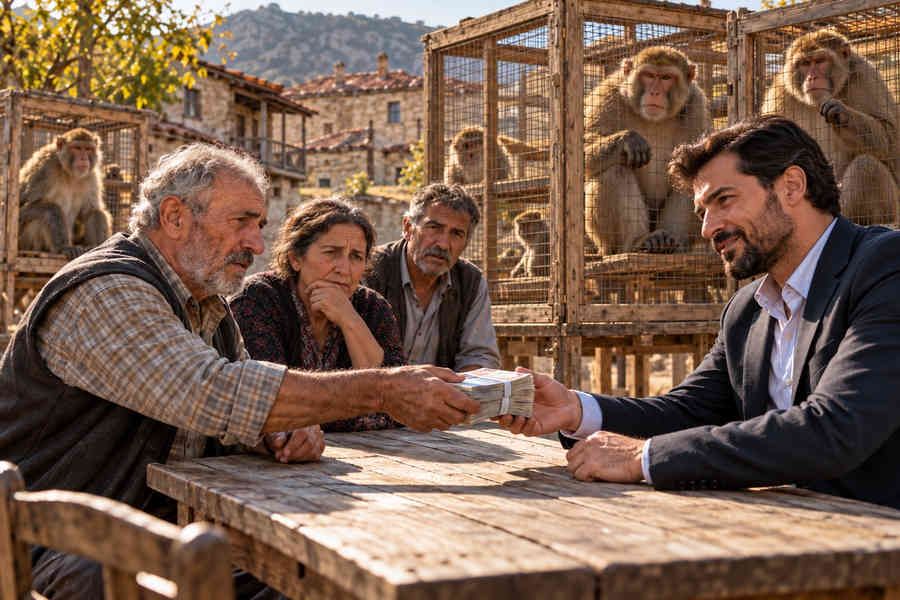
One day, a stranger comes to a village. He tells the villagers that he will pay them 100 lira for every monkey they bring him from the forest. There are plenty of monkeys in the area. The villagers rush into the forest. They catch the monkeys and bring them to the man. It is easy work: catch a monkey, collect the money.
A few days later, the man raises the price to 200 lira. Then 300. Then 500.
The villagers now take the business seriously. They head into the forest early in the morning and spend the entire day chasing monkeys. Everyone is calculating how to earn more. Then the man says:
“I have to go to the city. I’ll be back in a week. When I return, I’ll pay 1,000 lira for every monkey.”
He leaves, but he leaves his assistant behind in the village. A few days later, the assistant gathers the villagers.
“All the monkeys my boss has collected are in cages,” he says. “If you want, I’ll sell them to you for 700 lira each. When my boss returns, you can sell them to him for 1,000 lira. You’ll make 300 lira on every monkey.”
The calculation is simple: Buy at 700. Sell at 1,000. Make 300 lira.
For the villagers, this is no longer simply a transaction. It is an opportunity that must not be missed. Some sell their cows. Some mortgage their fields. Others put up the money they have saved for years.
Eventually, every monkey in the cages is bought for 700 lira.
The next day, neither the man nor his assistant is anywhere to be found. The village is left with a large number of monkeys and a large number of people who have lost their money. There is no one left to buy the monkeys for 1,000 lira.
The villagers did not actually buy monkeys.
They bought a dream of money they expected to make in the future.
This simple story makes me think of the high-return promises and Ponzi schemes that occasionally emerge in Turkey. In recent years, the public has closely followed the Seçil Erzan case, in which money was reportedly collected from people through what was presented as a high-return private fund, while it was alleged that no such fund actually existed. The story of the monkeys inevitably brings that case to mind.
But there is another point here that deserves some thought.
People did not trust the promise of high returns alone. They trusted the people who recommended the funds and whom they believed had connections to the state.
They trusted these people's professions, backgrounds, social circles, political connections, and the things they said.
“This opportunity isn't available to everyone.”
“This is a very special fund.”
“Big names are investing too.”
“If you get in, you can make serious money in a short time.”
Sometimes, what makes an investment opportunity attractive is not the number itself.
It is the trust we place in the person quoting that number.
And that is where the danger begins. Because once we trust a person, we sometimes forget to ask how the money is actually going to be made.
The villagers in the monkey story really do make money at first. They sell monkeys for 100 lira. Then 200. Then 300. There is genuine profit at the beginning. That is why they believe the story.
The first profit creates confidence in the second. The second convinces them that even greater profits are possible. After a while, something very dangerous happens in the human mind.
The question,
“Is this really making money?”
is replaced by:
“How much more can I make?”
This is precisely where we need to be careful. Wanting to make money is not inherently wrong. We all want to live better, provide better opportunities for our children, and secure our future.
The problem is that the promise of easy and quick money can eliminate our need to question it.
If someone believes they can double money they have saved over many years within a few months, excitement is a natural response. But as excitement grows, the desire to ask questions may diminish.
In such situations, I believe the first question should not be:
“How much will I make?”
The real question is:
“Where will this money come from?”
If an investment promises a 30 percent return, where does that 30 percent come from?
Who is paying it?
What economic activity generates it?
What is the risk?
Where is the money actually held?
Where are the official documents?
Can the claims be independently verified?
And most importantly:
“Will I really be able to get my money back when I want it?”
If these questions cannot be answered clearly and openly, the size of the promised return should make us less excited, not more. Because in the financial world, high returns often come with high risk.
The combination of “risk-free, high, and guaranteed returns” should be an especially strong warning sign.
What the assistant in the monkey story does is actually a clever psychological trick. He is not merely selling monkeys to the villagers.
He is selling them a future worth 1,000 lira.
Instead of looking at the 700 lira they have in their hands today, the villagers focus on the 300 lira they believe they will earn tomorrow.
The human mind can sometimes work this way. We let go of real money in our hands and chase profits that have not yet materialized.
“Don’t miss this opportunity.”
“If so many people are doing it, they must know something.”
“If I don’t get in now, it will be too late.”
“Why wait when I can make this much in a month?”
Each of these sentences may sound harmless.
But sometimes they encourage us to act quickly rather than think carefully.
And haste is a poor adviser when it comes to financial decisions.
At the end of stories like these, it is not only money that is lost.
Sometimes people lose money they have saved for years.
Sometimes their homes.
Sometimes their businesses.
Sometimes the trust of their families.
But the heaviest loss may be the question people ask themselves:
“How did I not see this coming?”
It is easy to see when someone else has been deceived.
Accepting that we ourselves have been deceived is much harder.
Perhaps that is why the most painful part of financial fraud begins after the money is gone.
People replay past conversations in their minds.
“I should have asked a question at that point.”
“I should have asked for documentation.”
“I should have stopped and asked how such a high return was possible.”
But by then, it is too late.
That is why, to me, the real lesson of the monkey story is slightly different from a simple warning against greed.
Sometimes people lose money not because they want to make too much, but because they fail to ask enough questions.
No matter how attractive an investment opportunity may seem, it is worth stopping for a moment and asking:
“Am I really making an investment, or am I paying money for a story someone has told me?”
Because sometimes the way to make money is not to seize an opportunity, but to walk away from the wrong opportunity in time.
And perhaps the most expensive mistake in financial life is not making the wrong calculation.
It is stopping the calculation altogether.