
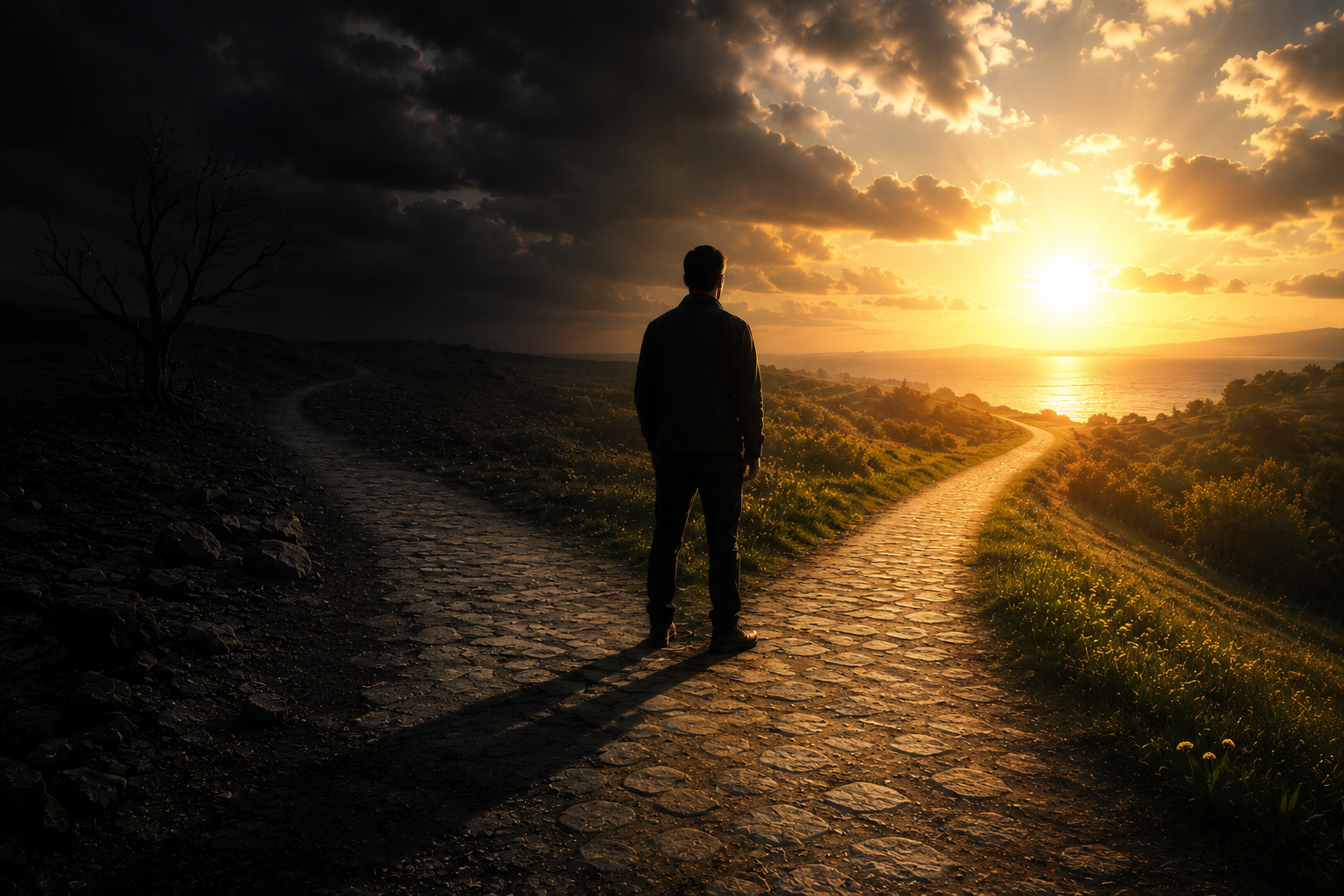
The One Who Turns Their Back on the Sun Walks in the Shadow
Life is, in many ways, a series of choices about direction. Every step we take does more than move us from one place to another; it reveals what we are choosing to face. For the direction we look toward gradually shapes our thoughts, our thoughts shape our character, and our character ultimately shapes our destiny.
There is an old saying rich with wisdom:
"The one who turns their back on the sun walks in the shadow."
At first glance, it appears to describe nothing more than a simple physical fact. Yet if we pause to reflect, we discover that it also expresses a profound truth about the human spirit.
Here, the sun symbolizes hope, science, knowledge, love, virtue, and truth. The shadow represents our fears, ambitions, anger, and illusions. When we turn our backs on the light, our shadow falls before us. It becomes the focus of our attention. The more we try to escape it, the larger it seems to grow; the more we try to catch it, the farther away it appears.
Many of life's dead ends begin in exactly this way.
Some people spend their lives preoccupied with what others are doing. Some remain trapped by hurts they suffered years ago. Others long for what they never had, while still others live in constant fear of losing what they already possess. Without realizing it, they devote all their energy to chasing their own shadows. More often than not, what exhausts them is not what happened to them, but their inability to let it go.
Yet no one reaches the light by fighting the shadow.
People often search for the source of their unhappiness in the outside world. They believe they will find peace if they earn more money, attain a higher position, or receive greater recognition. Yet none of these can replace the light that is missing within. The real issue is rarely the road we travel, but the direction in which we are looking.
There are people who preserve their hope even during the darkest chapters of their lives. What sustains them is not the absence of suffering, but their ability to keep their faces turned toward the light. They do not deny the existence of the shadow. They understand that it is a natural part of life. But neither do they allow it to become their guide.
Others, by contrast, possess every imaginable opportunity yet live with a persistent sense of emptiness. Their attention remains fixed on their shadows. Every criticism feels like a personal attack, every failure becomes an irreversible defeat, and every loss appears to be the end of life itself. In time, they lose the ability to recognize the beauty that still surrounds them.
The shadow is never our true enemy. It is merely a quiet companion, reminding us that light exists. The real danger lies not in having a shadow, but in allowing it to lead us.
This truth applies not only to individuals but also to societies. When a society stops looking toward the future with confidence and begins feeding its fears instead, it too starts walking in the shadow. When people choose accusation over understanding, consumption over creation, and prejudice over learning, they have, often without realizing it, turned their backs on the sun.
Perhaps this is why education is far more than the transmission of knowledge. Its highest purpose is to teach people how to turn toward the light once again. When our direction changes, our path changes as well. And when our perspective changes, the meaning of life begins to change with it.
Perhaps, from time to time, each of us should ask ourselves the same question:
Where am I truly looking?
Are my thoughts consumed by fear, anger, resentment, and the past? Or am I nurturing hope, values, and the future?
For the course of our lives is determined not only by the steps we take, but also by the direction in which we choose to face.
When we turn once again toward truth, goodness, love, and hope, our shadow will still exist. But it will no longer lie before us—it will remain quietly behind us.
Perhaps this is where genuine wisdom begins.
Those who truly seek freedom should not devote themselves to destroying their shadows, but to turning toward the sun.
And perhaps the essence of all these reflections can be captured in a single sentence:
"The one who turns their back on the sun walks in the shadow."