
THE DIRECTION OF BALANCE
Whenever I think of balance, the same image always comes to mind: a scale with both pans perfectly still, resting exactly at the center. As if balance were a destination we needed to reach as though, once we arrived there, nothing would ever change again. Yet life shows us that this is not the case at all. True balance does not lie in remaining still; it lies in adapting to changing circumstances and being able to readjust ourselves when necessary.
A tightrope walker does not stay balanced by becoming rigid and refusing to move. Quite the opposite: with every step and every slight sway, they redistribute their weight. We do much the same in life. In our joys, losses, successes, and disappointments, we gather ourselves, recover, and try to find our balance again. And how we do this often depends on which direction we are most likely to be thrown off course.
Because every person has their own particular tendencies. Some are quick to anger; others can never quite escape the shadow of anxiety. Some are so generous that they forget their own boundaries, while others fail to notice when frugality has turned into stinginess. For this reason, balance cannot be established at exactly the same point for everyone.
For an angry person, finding balance does not mean becoming tougher; it may mean learning patience. For an anxious mind, what is needed may not be greater caution, but a little more courage. For someone overly attached to accumulating things, balance may lie in learning to share; for a spendthrift, it may be found in the peace of moderation.
This reminds me of a short story I heard many years ago.
THE BAMBOO AND THE WIND
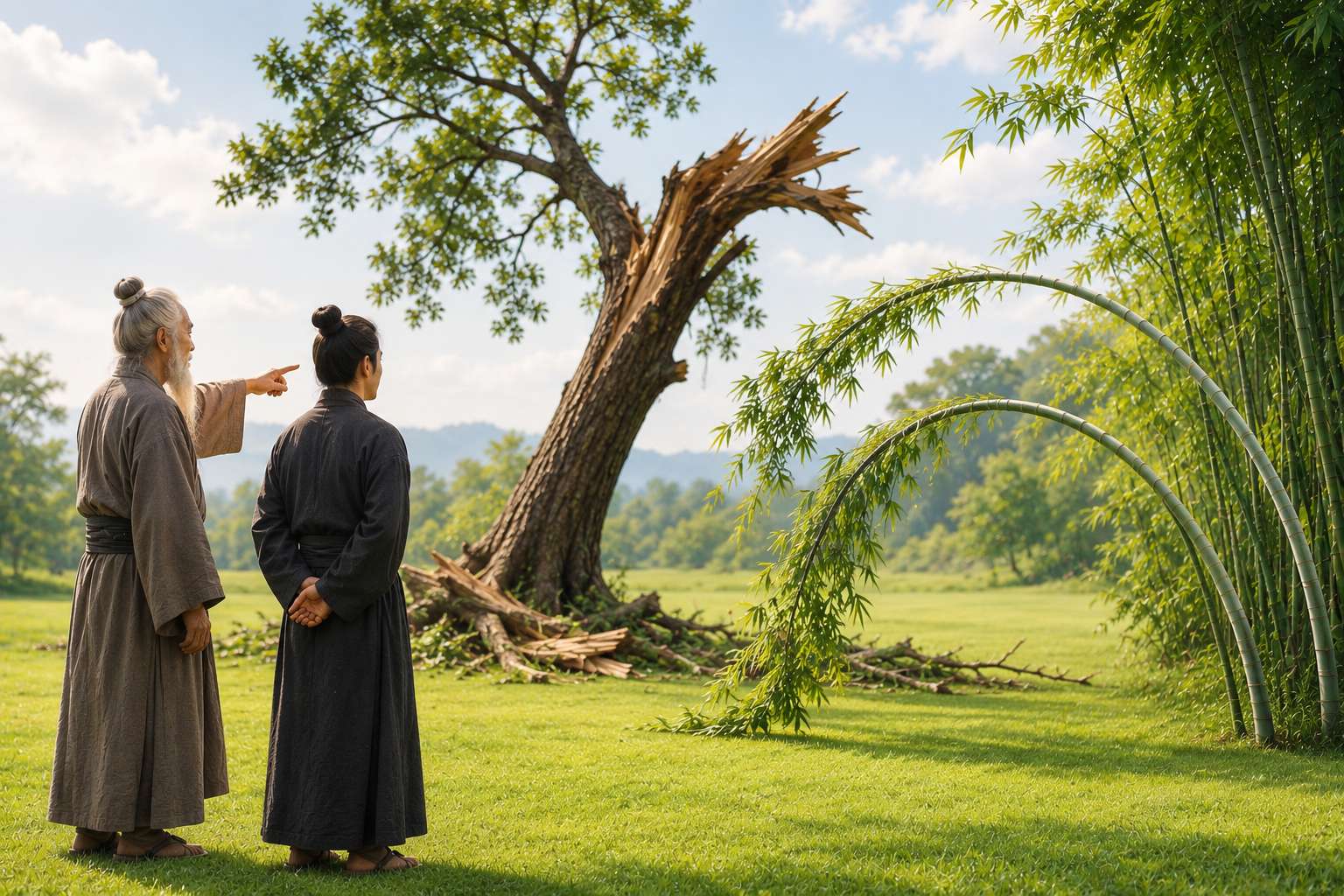
In a remote village, an old sage takes his student to the edge of a forest. After walking silently for a while, he points to a large tree standing before them.
“Look at that tree,” he says. “How strong and magnificent it is.”
Just then, a powerful wind begins to blow. The great tree struggles against it with all its strength. Its branches crack and its trunk shakes violently. After a few minutes, a large branch breaks off and falls to the ground.
The sage points to the bamboo growing a little farther away.
The bamboo bends with the wind, almost touching the ground. Yet no matter how fiercely the wind blows, it eventually rises again.
The student asks in amazement:
“Master, how could the great tree break when it was so much stronger, while the bamboo remained standing?”
The sage smiles.
“Because you think strength means nothing more than resisting.”
After a moment of silence, he adds:
“Sometimes, the way to remain standing is not to resist, but to know when to bend.”
The student looks at the bamboo.
The sage continues:
“Life is like that, too. If you try to resist everything, one day you will break. But if you change direction with every gust of wind, you will lose your roots. Wisdom lies neither in always bending nor in always resisting. True wisdom is knowing when to stand firm and when to be flexible.”
The student remains silent for a long time.
As they leave the forest that day, he walks differently. He had always thought that balance meant standing perfectly still. Now he understands something else:
Balance is not the absence of wind; it is being able to move without falling when the wind blows.
This is true not only for individuals. Relationships, institutions, and societies also depend on the same delicate balance. A person who is always giving may one day find themselves exhausted without even realizing it. Someone who is always taking may eventually wonder why they have been left alone.
Sometimes balance means gathering all our courage and saying, “No.” At other times, it means setting aside our ego, pride, and habits and saying, “I’m sorry.” Which word, which action, or which silence will restore our balance depends on which side we have been leaning toward too much.
We can see this delicate line in education as well. A teacher who only criticizes may eventually extinguish a student’s curiosity. An approach based solely on praise, however, may create a fragile sense of confidence disconnected from reality. Love and boundaries, freedom and responsibility are not opposites. On the contrary, they are two weights that complement each other. Being able to see which side has become too light may be one of the most important skills of a good educator.
Yet the most difficult part is recognizing our own tendencies. We often regard our excesses as normal, even necessary. Someone who appears arrogant may be carrying a deep sense of vulnerability inside. Someone who seems excessively humble may, perhaps, be a silent captive of their fears.
True balance begins with the courage to look at ourselves honestly, but also compassionately. We cannot find balance without seeing where we have been leaning too far. This is a difficult truth to accept, but it is also one that can set us free.
Nature learned this lesson long before we did. A tree standing rigidly against the wind may be the first to break in a violent storm. The one that knows how to bend a little may remain standing.
We do not need to be completely rigid, nor do we need to surrender entirely. Life finds its meaning along that delicate line where resilience and flexibility meet.
Perhaps this is the most important kind of balance life is trying to teach us:
To move with the wind without giving up our roots.
Balance is not a place we find somewhere outside ourselves. We build it within, through honesty and patience. And in the end, the needle of the scale always returns to the same question:
Which direction have you actually been leaning too far toward?