
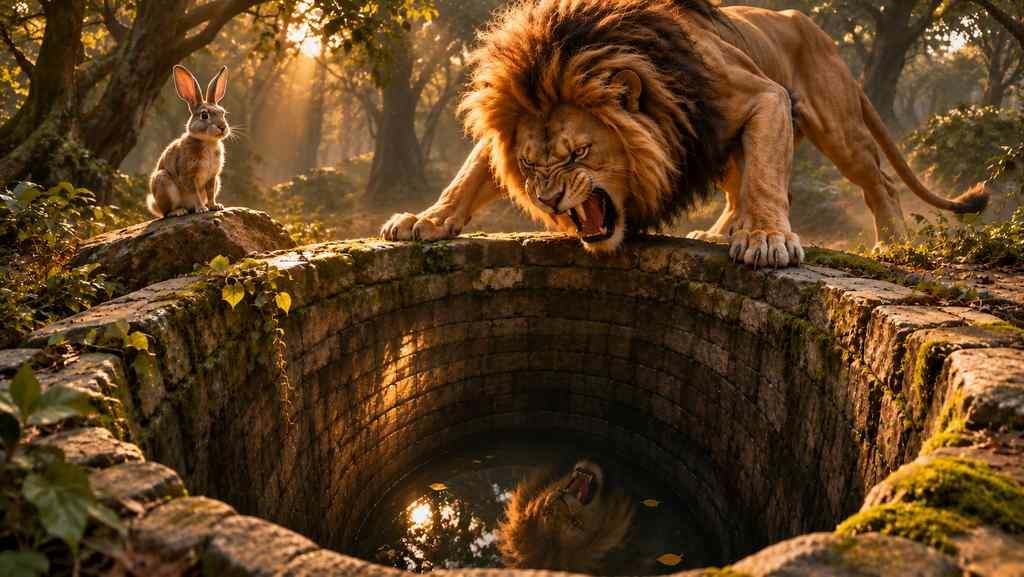
When Strength Falls Into Its Own Trap
I have a few questions for you:
“Does being strong always mean being right or successful? Must we necessarily be stronger than a problem in order to solve it? Or can a little wisdom, some patience, and a small step taken at the right moment sometimes render even the greatest power ineffective?”
I would like to share a forest fable that offers some wonderful answers to these questions.
Once upon a time, there lived a powerful lion in a forest who considered himself the mightiest creature in the world. Every day, he went hunting. Deer, monkeys, wild boars, peacocks, and porcupines were all vulnerable to his attacks. All the animals in the forest had begun living in constant fear. None of them felt safe.
Eventually, the animals could take it no longer. They gathered together and went to the lion's cave. They made him a proposal:
"Your Majesty, instead of hunting every day and terrorizing all the animals in the forest, let us send you one animal each day. That way, you will never go hungry, and the rest of us will no longer have to live in fear."
The lion accepted their proposal. For a while, peace prevailed in the forest. Each day, one designated animal went to the lion's cave, while the others were given at least one more day to live.
Then, one day, it was a rabbit's turn.
But this rabbit was different from the others. He knew that his small body stood no chance against the strongest animal in the forest. Yet he also realized that defeating the lion did not necessarily require a physical confrontation. He decided to confront strength not with greater force, but with intelligence.
The rabbit deliberately made his way toward the lion's cave at a very slow pace. By then, it was well past noon. When the starving lion finally saw the rabbit, he roared furiously:
"Where have you been? Why are you so late?"
The rabbit replied, pretending to be frightened:
"Your Majesty, I was on my way to see you when another lion blocked my path. He declared himself the king of the forest and said he did not recognize your authority. He even held me back, insisting that I would not be allowed to come to you."
The lion's eyes blazed with anger.
"What do you mean, another lion? There can be no king in my forest but me! Where is he? Take me to him immediately!"
The rabbit led the lion to a deep well near the forest. Looking into the well, the lion saw another lion on the surface of the water, one that looked exactly like him. He failed to recognize his own reflection. He roared furiously, and the lion in the well roared back.
Taking this as a challenge, the lion leaped into the well without a moment's hesitation, determined to destroy his rival. But as he struggled against his own reflection, he drowned in the deep water and never made it out.
And so, the animals of the forest were finally freed from the lion who had kept them in fear for so long. What made this possible was a rabbit, one of the smallest and physically weakest creatures in the forest.
When I reflect on this story, many examples from human life come to mind.
Power is an important resource. However, how we use that power is far more important than the power itself. People who cannot control their strength, who try to solve every problem through brute force, and who see everyone who challenges them as a threat eventually become prisoners of their own power.
That is precisely what happened to the lion. He could not imagine that another force might exist beyond his own. He failed to control his anger, did not question what he was being told, and acted without thinking. What led to his downfall was not the rabbit's physical strength, but his own inability to control his emotions.
We encounter similar situations in everyday life. Sometimes, people in positions of authority perceive even the slightest criticism as a personal challenge. They use their power to silence others and keep them under pressure. Yet true strength does not lie in being able to silence everyone. It lies in listening to different opinions and having the courage to acknowledge one's own mistakes when necessary.
I believe this distinction is particularly important in leadership. A leader's success depends not on how much people fear them, but on how much they trust them. Fear may produce temporary obedience, but trust creates genuine commitment. A system built on fear is bound to collapse when the weakness of the person who appears powerful is finally exposed.
There is another important lesson in the rabbit's success:
“Not every problem can be solved through direct confrontation. Sometimes, we need to pause, think, understand the circumstances, recognize the other side's vulnerabilities, and find a different way forward. We should never underestimate our own abilities simply because the obstacle before us seems overwhelming.”
Of course, the rabbit's method in this story relies on deception and distorting the truth. We cannot advocate solving every problem this way in real life. However, the central message of the story is that physical strength does not always guarantee superiority, and intelligence can reveal new ways forward, even under the most difficult circumstances.
Perhaps what we should really consider is not how much power a person possesses, but how wisely and responsibly that person uses it.
People who rely too heavily on their strength often see no need to think things through. They cannot tolerate being challenged or contradicted. A wise person, on the other hand, understands that not every battle needs to be won and that sometimes the best way to reach a goal is to avoid the confrontation altogether.
Ultimately, strength may enable us to defeat others, but wisdom prevents us from defeating ourselves. And when we cannot overcome ourselves, no amount of power will ever be enough to save us.