
WHAT WE SAY ABOUT OTHERS REVEALS WHO WE ARE
If you want to get to know someone, pay a little less attention to what they say about themselves and a little more attention to what they say about other people. Because when we talk about others, we often reveal our own character without even realizing it.
A parable I read years ago illustrates this beautifully:
Two mullahs set out to preach in villages and, along the way, are invited to spend the evening at the home of a spiritual guide. After a while, one of the mullahs goes outside to perform his ablution. The host turns to the mullah who remains inside and asks:
“Mullah, what is your companion like as a scholar? Is he a good man? Are you pleased with him?”
Without hesitation, the mullah replies:
“Him? He’s a donkey! He’s completely ignorant.”
Just then, the other mullah comes back inside, and the conversation ends.
A little later, the other mullah goes outside to perform his ablution. The host asks him the same question. This mullah has no hesitation about talking behind his companion’s back either:
“Oh, for heaven’s sake! He’s an ox. He’s ignorant, quarrelsome, stubborn... What could I possibly be pleased with? Somehow I ended up traveling with him and became his companion.”
And so, the two mullahs reveal what they really think of each other.
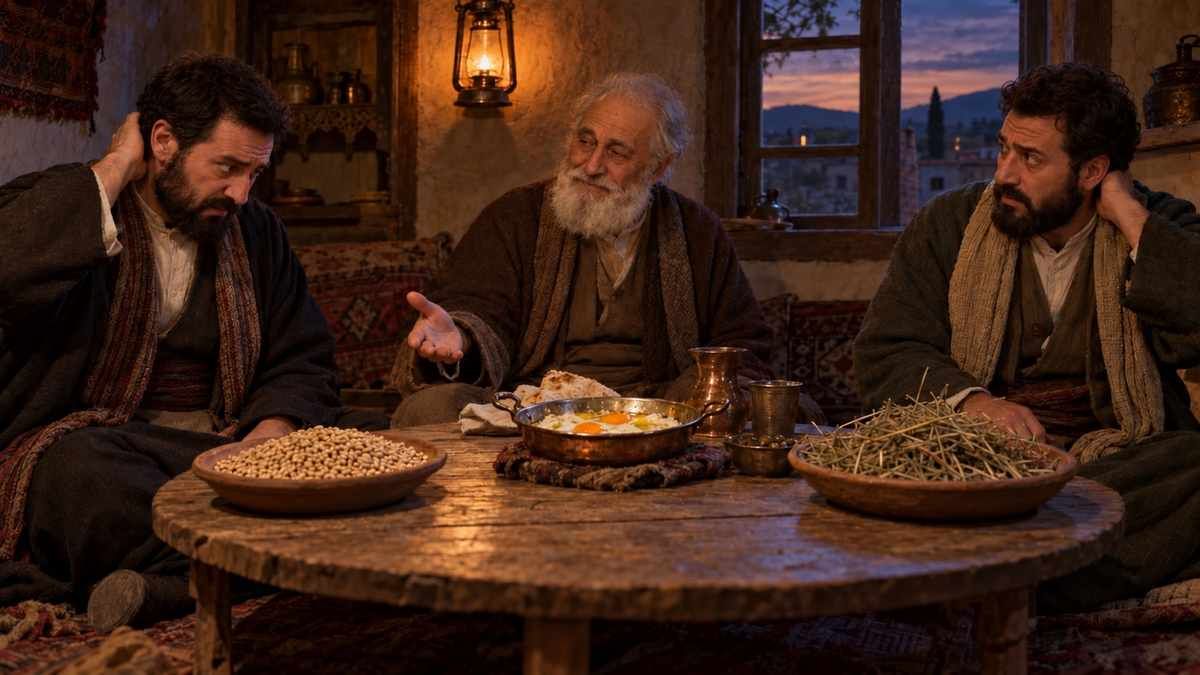
That evening, it is time to break the fast. Three covered dishes are placed on the table. In front of one mullah there is barley; in front of the other, hay. In front of the host, there are delicious eggs fried in butter.
The mullahs look at each other in bewilderment. The host smiles and explains:
“I did nothing wrong. I asked your companion about you, and he said you were a ‘donkey.’ So I put barley in front of you. Then I asked you about him, and you said he was an ‘ox.’ So I put hay in front of him.”
Then he points to his own plate:
“And since I am a human being, the eggs are for me.”
The parable ends there, but that is really where the important part begins.
Because all of us have tables where we sit and talk about other people.
We talk about a friend behind his back. We point out a colleague’s shortcomings. We belittle a relative. Sometimes we look at a few faults in a person and pass judgment on the whole of them.
And then we defend ourselves by saying:
“I’m just telling the truth.”
But telling the truth is one thing; humiliating someone is another.
We can criticize someone’s behavior. We can point out a mistake. We can even strongly disagree with someone. But none of that gives us the right to demean that person.
That is exactly where the two mullahs go wrong. They do not simply criticize their companions’ behavior; they reduce them to animals. And, worse, they say things behind their backs that they would not dare say to their faces.
To me, the best part of the parable is the lesson the villager teaches them.
He does not give them a long moral lecture. He does not get angry. He does not insult them.
He simply puts their own words in front of them.
“If this is what you said about your companion, then here you are. Now face the consequences of your own words.”
Sometimes that is the most effective lesson life can teach us.
When we judge other people, we often see ourselves sitting in the judge’s chair. We quickly decide who is good and who is bad. But sometimes life takes that chair away from us.
The words we say about someone today may be said about us tomorrow.
A quality we mock in someone today may become our own weakness tomorrow.
The mistake we laugh at in someone else today may be the very thing that tests us tomorrow.
That is why we need to be a little more careful when we talk about other people.
Because our words do not only describe the person we are talking about; they also reveal who we are.
One of the best ways to understand someone’s character is to listen to how they talk about people who are not present.
Friendship is tested here, too.
It is easy to treat a friend well when they are standing right in front of us. The real test is how we talk about them when they are not there.
Perhaps true morality begins exactly here:
Being able to show the same respect for a person in their absence that we show them to their face.
The barley and hay in the story of the two mullahs may seem funny.
But each of us has an invisible plate in front of us.
On that plate are all the things we have said about other people.
And when that plate is eventually placed in front of us, what we find on it will have been prepared by the words we choose to speak today.
What do you think tells us more about a person: listening to what they say about themselves, or paying attention to what they say about other people?