
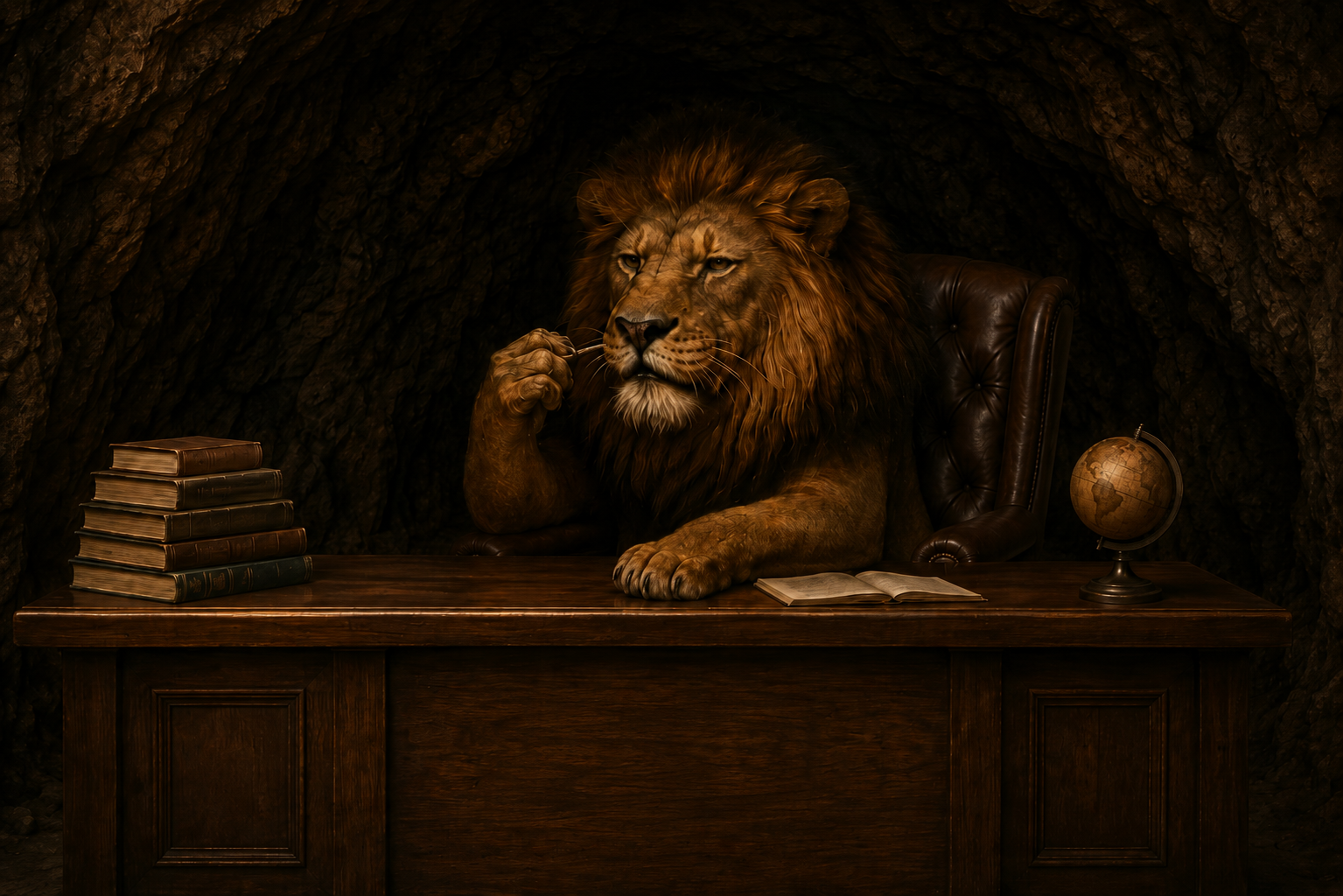
Truth Without a Lion
Truth does not always lose because it is weak. Sometimes it loses because power speaks louder.
In every corner of society, people are taught to admire confidence, titles, influence, and authority. A statement delivered from a podium is often accepted more easily than one spoken quietly from the margins. The louder the voice behind an idea, the more legitimate that idea appears to become. Over time, many stop asking whether something is true and begin asking only who is powerful enough to defend it.
This pattern repeats itself everywhere.
In academia, respected names can overshadow stronger arguments from unknown minds. In politics, power often shapes public perception more effectively than facts. In business, influential connections can carry weak ideas farther than genuine talent. Even in ordinary life, people frequently judge appearances before substance, confidence before evidence, status before integrity.
Truth rarely enters the room wearing a crown.
There is an old story that captures this reality with uncomfortable precision.
Deep in the forest, a rabbit sat at a typewriter, furiously typing away.
Click clack. Click clack.
A fox passing by stopped and asked,
“What are you writing?”
“My doctoral dissertation,” replied the rabbit calmly.
“About what?”
“About how rabbits eat foxes.”
The fox burst into laughter.
“That’s absurd. Everyone knows rabbits don’t eat foxes.”
The rabbit looked up and said,
“Come with me. I’ll show you.”
The fox followed the rabbit into its burrow.
Moments later, the rabbit emerged alone and resumed typing.
Click clack. Click clack.
Later, a wolf approached and asked the same question.
“I’m writing about how wolves are defeated,” said the rabbit.
The wolf laughed even harder.
“Who would believe such nonsense?”
“Come see for yourself,” the rabbit replied.
The wolf entered the burrow.
Again, the rabbit came out alone.
Inside the burrow lay the answer: the bones of the fox in one corner, the bones of the wolf in another, and in the middle sat a massive lion, calmly picking its teeth.
The rabbit’s dissertation was not accepted because its arguments were convincing. It was accepted because a lion stood behind it.
That story survives because people recognize it instantly.
Many ideas succeed not because they are true, but because they are protected by institutions, wealth, influence, or fear. The public often mistakes amplification for wisdom and authority for correctness. A powerful person repeating a weak idea can drown out a truthful voice that lacks backing.
This does not mean truth has no value. It means truth alone is often forced to compete against machinery far louder than itself.
That is why intellectual honesty matters so deeply.
A healthy society depends on people willing to look beneath appearances and ask difficult questions:
Is this idea actually sound?
Does this person deserve their authority?
Is this success built on merit, or on invisible power standing behind the curtain?
These questions are uncomfortable because they threaten systems built on reputation and influence. Yet without such questioning, societies slowly drift toward performance instead of principle.
Power itself is not evil. When guided by conscience, justice, and humility, power can protect the vulnerable and strengthen civilization. But power detached from morality becomes dangerous. It begins to manufacture reality instead of seeking it. It rewards obedience over honesty and appearances over substance.
History repeatedly shows the same lesson: power can shape perception for a time, but eventually reality collects its debt.
What endures is not intimidation, wealth, or status. What endures is truth defended with integrity, even when it stands alone.
A society begins to decay when people stop asking whether something is true and start asking only who is powerful enough to say it.
Because in life, sometimes it is not the thesis that wins.
It is the lion standing behind it.