
THE VANISHED WAYSTATION
I don’t know whether you have read Zülfü Livaneli’s novel The Last Island. If you haven’t, I highly recommend it. To avoid spoiling the story for those who may wish to read it, I won’t go into too much detail.
The novel explores, through powerful symbolism, the rise of authoritarianism, the psychology of crowds, how easily freedom and democracy can be be lost, how interfering with a single species can disrupt an entire ecosystem, and the consequences of remaining silent in the face of injustice.
On a small, unnamed island, people with different beliefs and opinions have lived together peacefully for years. One of the island’s most distinctive features is its seagulls, which roam freely alongside the residents. A delicate balance exists between nature and human life.
One day, a former president, once one of the country’s most powerful political figures, settles on the island. At first, he appears to be nothing more than a charismatic retiree seeking a quiet life. Gradually, however, he begins influencing the islanders, gathering followers, and reshaping the island’s way of life.
One of his first targets is the seagulls. He claims they are noisy and make life unpleasant. What begins as minor measures against the birds gradually turns into increasingly harsh actions. The natural balance is destroyed. As the seagulls disappear, rats multiply, the environment deteriorates, and the island loses the peace that once defined it.
I realize I’ve gotten carried away and started summarizing the novel, so I’ll stop here. The former president’s attempt to eliminate the seagulls inspired the idea for another essay, which explains this unusually long introduction and book review. Since I am not a master storyteller, I failed to express my point as briefly and directly as I intended.
In truth, my essay begins here.
Sometimes we sense that something is missing from our lives, yet we cannot quite identify what it is. From the outside, everything appears to be in order. Life goes on, routines remain intact, and nothing seems obviously wrong. Yet the compass within us has somehow lost its direction. We walk the same roads, stumble over the same obstacles, and cannot understand why we no longer move forward.
More often than not, we blame ourselves. We assume the problem lies within our own shortcomings. But perhaps the problem is not us at all. Perhaps the most important stop on our journey is no longer there. The place where we once paused to rest, where we felt safe, whose presence we never even questioned, has quietly disappeared.
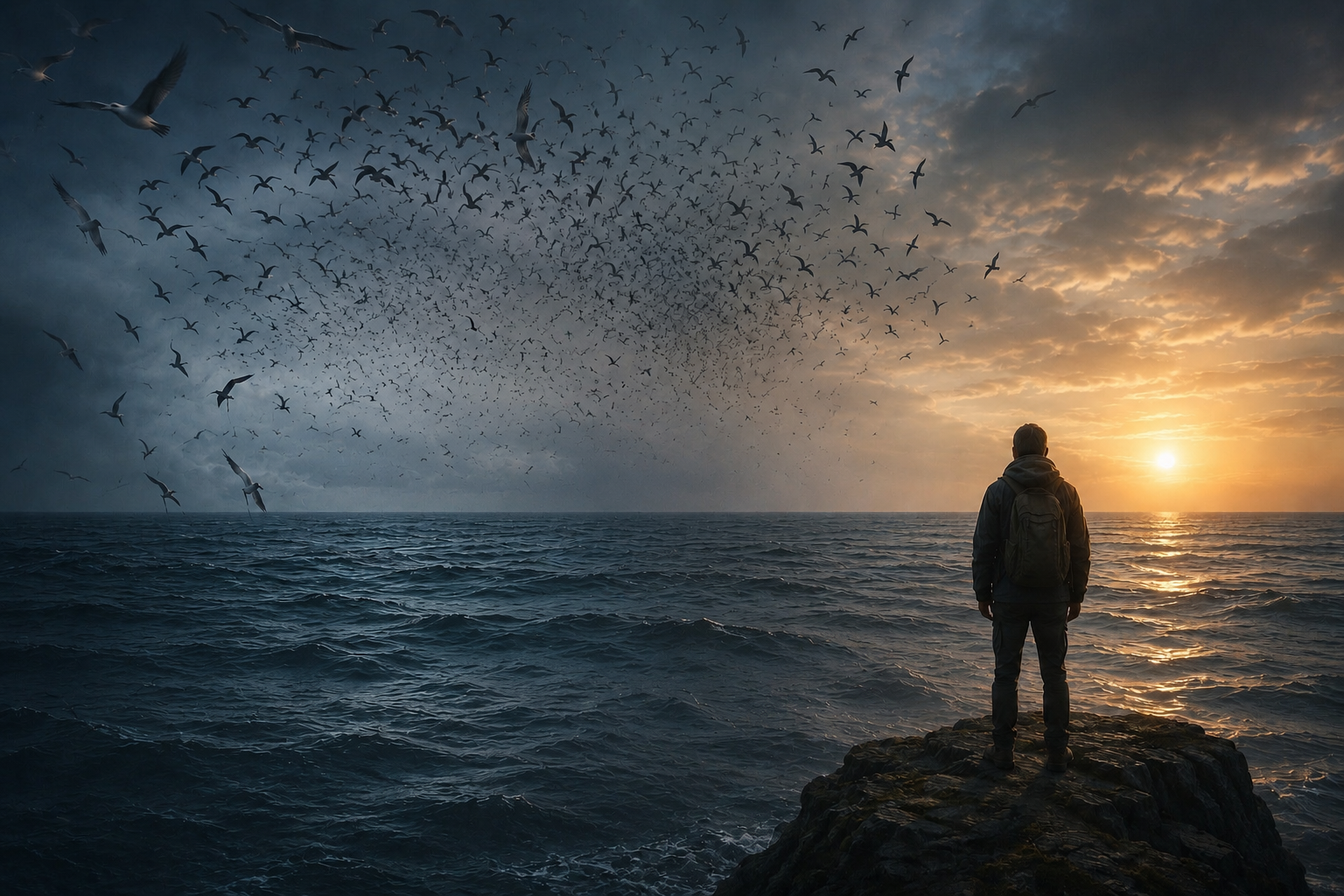
Years ago, the explorer Thomas Cook witnessed an unforgettable scene in the middle of the Atlantic Ocean. The sky was filled with millions of migrating birds, endlessly circling overhead while crying out in unison. Their calls were so overwhelming that they drowned out even the roar of the ocean itself. Most heartbreaking of all, some of the exhausted birds eventually surrendered, dropping into the towering waves below as though, having lost hope, they had also lost the will to live.
For many years, this mysterious phenomenon remained little more than a legend among fishermen and an unsolved puzzle for scientists. Observations revealed that migrating birds arriving from different continents consistently gathered at precisely the same point in the middle of the ocean. Yet no one could explain why. Why would they all fly toward a place where there appeared to be nothing at all?
After years of investigation, the answer finally emerged.
Long ago, a small island had stood at that very location. Situated directly along the birds’ migratory route, it had served as a resting place for countless generations. Then, following a massive earthquake, the island sank beneath the sea.
Invisible to people and erased from every map, the island remained far more than a piece of land to the birds. For thousands of years, it had been a sanctuary where they could safely rest and regain their strength. After each long and exhausting journey, they instinctively expected to find it once again. But when they arrived, it was gone.
Their waystation had vanished.
Unable to find the refuge they had always relied upon, they circled helplessly in the sky. Eventually, their strength failed them, and they surrendered themselves to the mercy of the ocean.
In truth, this is not merely the story of migrating birds. It is also the story of our own lives.
Sometimes we lose a person who once gave us strength. Sometimes we lose a value that sustained us, or a great purpose that once gave our lives direction. We become so accustomed to their presence that we hardly notice their absence at first. Yet, little by little, an emptiness begins to grow within us. We work harder, struggle more intensely, and keep moving in circles. Still, we cannot understand why happiness eludes us or why we seem unable to move forward.
The reason is often simple. What we still believe to be there quietly left our lives long ago. The world has changed, but we continue walking according to old maps and familiar habits. We keep heading toward islands that no longer exist, and when no answers come, we stubbornly repeat the same journey.
Life quietly reminds us of another truth.
Some waystations truly disappear.
Some roads close, never to open again.
Real courage lies not in denying these realities but in accepting them and finding the strength to chart a new course.
What sustains us is not blind loyalty to the maps of the past. Our greatest strength is our ability to discover a new direction when the old one no longer leads anywhere.
Life does not move forward by mourning sunken islands forever. It moves forward when we gather the courage to discover, across the vast sea before us, a new hope, a new resting place, and a new path!