
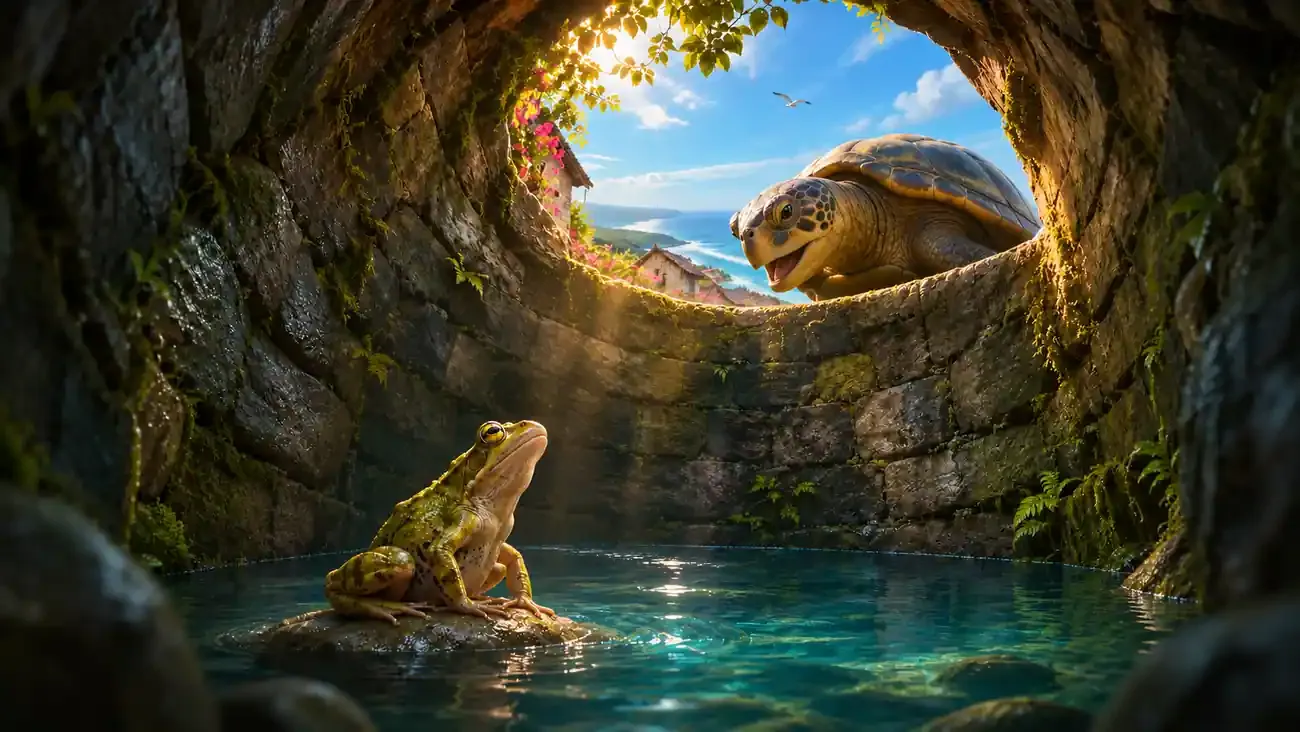
THE FROG IN THE WELL: WHEN IGNORANCE MISTAKES ITSELF FOR WISDOM
Once upon a time, a frog lived at the bottom of an old village well. Every day, he would look up at the small patch of blue sky visible through the opening. Over time, he became so accustomed to this view that he began to believe it was all there was to the world. As far as he was concerned, both the sky and the world ended at the walls of his well.
One day, an old sea turtle passing by heard noises coming from inside the well and looked down.
“Hello, little frog. How are you?” he asked.
The frog proudly replied:
“I'm very well. I live all by myself in this lovely well. I swim whenever I want and rest whenever I feel like it. And I have a beautiful blue sky above me. What more could I ask for? This is my world.”
The turtle smiled.
“Have you ever seen the ocean?” he asked.
“The ocean? What's that?” said the frog.
“The ocean is an enormous body of water. You could travel for days and still not reach the other shore. It is so vast that you cannot see where it begins or ends.”
The frog burst out laughing.
“That's impossible! I can jump from one side of this well to the other in just a few leaps. There can't possibly be any body of water bigger than my world!”
The turtle tried to explain, but the frog refused to listen. He could not even imagine that a world might exist beyond what he had seen. Eventually, the turtle went on his way, while the frog remained in his well, spending the rest of his life believing he knew everything there was to know about the world.
This story reminds me of some of the street interviews we see in Türkiye. A reporter walks around with a microphone, asking people questions about space, the economy, education, foreign policy, or living conditions in other countries. Within minutes, we hear such firm and confident judgments that it is hard not to be surprised.
Some people who talk about the economy are unfamiliar with even its basic concepts. Some who criticize the education system have never read a single study on education. Others speak with great authority about foreign countries without knowing how they are governed, what their economic conditions are like, or how their societies function.
Yet they express no doubt whatsoever about what they say. They speak with absolute certainty about subjects they know little about and sometimes look down on those who disagree with them. Instead of asking questions and doing research, they prefer to pass judgment.
Of course, it would be unfair to assume that everyone who takes part in street interviews is uninformed. People can offer valuable insights into the country's problems based on their own life experiences. In fact, one of the strengths of street interviews is that they give different segments of society an opportunity to express their views. But drawing sweeping conclusions about the entire world from one's limited personal experience is something quite different.
One of the most striking examples of this attitude is the claim we occasionally hear: “Germany is jealous of us.”
Some people who have never visited Germany, never lived there, never experienced the everyday life of an ordinary German citizen, and never investigated the country's economic or social conditions can speak with absolute confidence about how much Germany supposedly envies Türkiye.
It is only natural to ask: What exactly are they jealous of?
The income levels of people in Germany? Their working conditions? Their healthcare and education services? Their social security system? Or are they jealous of the rising cost of living, income inequality, and economic difficulties people face in Türkiye?
Instead of answering these questions with facts and figures, a few slogans are often considered sufficient.
Germany is certainly not a perfect country. It has its own economic problems, political debates, and social tensions. But criticizing a country's shortcomings is one thing; dismissing it without knowing anything about it is quite another. To make a fair assessment of another country, we need to understand how its people live, how much they earn, how much tax they pay, what its inflation rate is, and what challenges they face.
People can form firm opinions even about countries they have never seen. More often than not, however, these opinions reflect what they want to believe rather than what is actually happening. Instead of questioning their own assumptions, they look for statements and images that confirm them.
This attitude is not limited to the way we judge other countries. We form opinions about authors without reading their books, criticize researchers without examining their studies, and reject ideas without making an effort to understand them. We mistake the opinions of people around us for the views of society as a whole.
One important lesson I learned during my long academic career is that we must also recognize the limits of our own knowledge. Having years of experience in a particular field does not mean we understand every aspect of it. Knowledge grows through curiosity, research, and a willingness to listen to different perspectives.
People who are genuinely willing to learn are not afraid to ask questions about things they do not know. When they encounter new information, they are prepared to reconsider their views. They see changing their minds not as a defeat, but as a natural part of learning.
The real problem is not ignorance itself, but failing to recognize our own ignorance. We begin to learn when we admit that we do not know something. But the moment we believe we know everything, we close every door through which new knowledge might enter.
That was precisely the frog's problem. What confined him was not simply the walls of the well, but his refusal to accept that another world might exist beyond them.
Perhaps we should occasionally ask ourselves:
Could I also be sitting at the bottom of my own well, mistaking the little patch of sky I can see for the entire world?
Our horizons expand not only through what we see, but also through the courage to remain curious about what we have yet to discover.
Not having seen the ocean does not mean it does not exist. Sometimes the greatest obstacle we need to overcome is not the walls of the well we live in, but the walls we have built inside our own minds.