
NOT EVERYONE BELONGS IN THE SAME PLACE
The way people see us does not always reflect who we truly are. Sometimes, because of other people's judgments, we begin to see ourselves as inadequate, worthless, or unwanted. When we struggle to fit into our surroundings, we assume that something must be wrong with us. Yet perhaps we simply have not found the right place where we can become who we are meant to be. Qualities that seem like shortcomings by someone else's standards may turn out to be our greatest strengths in a different environment.
This thought brings to mind a story we have known since childhood: The Ugly Duckling.
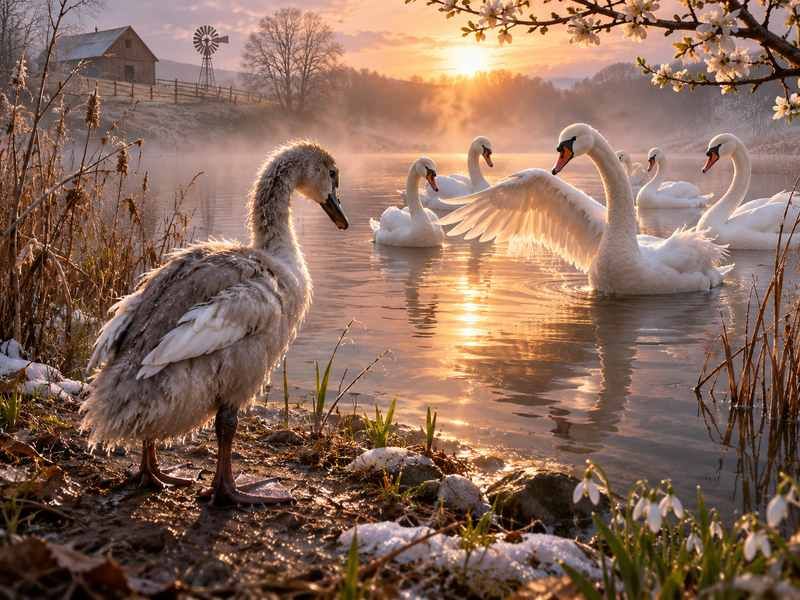
Once upon a time, a mother duck was waiting for her eggs to hatch. One day, the eggs began to crack open, one by one, and adorable little yellow ducklings emerged. But the last egg was different. After a long wait, it finally hatched, revealing a large, gray-feathered duckling that looked rather awkward and unusual.
The mother duck was surprised, but she welcomed him with the same affection she showed the others. His brothers and sisters, however, were not so understanding. They made fun of his appearance and refused to play with him. The other animals on the farm also considered him ugly and treated him as an outsider.
Feeling unwanted and lonely, the little duckling eventually decided to leave. One day, hoping to find somewhere he would be accepted, he set off on his own. He wandered through forests, fields, and unfamiliar places. Yet wherever he went, he continued to feel different from everyone else.
Then winter arrived. The lakes froze, and the fields were covered in snow. The little duckling struggled to survive the bitter cold. He had no family to look after him, no warm home to take shelter in, and no one to comfort him. Despite all these hardships, he kept going.
At last, spring arrived. The little duckling had grown bigger and stronger, and his appearance had begun to change. His neck grew longer, and his gray feathers gradually began to turn white.
One day, while wandering along the shore of a beautiful lake, he spotted a group of white swans gliding gracefully across the water. He watched them in admiration. They were so beautiful, he thought, yet he believed he could never be as beautiful as they were.
Then something unexpected happened. The swans noticed him and invited him to join them. For the first time, nobody laughed at him, rejected him, or looked down on him for being different. For the first time, he felt accepted as part of a group.
As the seasons passed, his remaining gray feathers gradually disappeared, replaced by beautiful white plumage. One morning, he caught sight of his reflection in the still waters of the lake. He could hardly believe what he saw. The creature everyone had once regarded as an ugly duckling had become a magnificent swan.
At that moment, he understood an important truth:
He had never been an ugly duckling. He was simply a swan who had not yet grown into his true identity and beauty.
This story makes me reflect on how easily our opinions of ourselves can be shaped by the judgments of others.
From childhood onward, we encounter the expectations of the people around us. Our families, teachers, friends, and the society we live in offer us various standards about how we should behave, what we should achieve, how we should look, and even how we should think. When we meet these expectations, we are accepted; when we fail to do so, we are criticized. Over time, we may begin to use other people's assessments of us as the standard by which we judge ourselves.
Yet every person has a different pace of development, different abilities, interests, and life circumstances. What one person achieves at an early age may take another much longer. Someone who struggles to demonstrate their abilities in one environment may accomplish extraordinary things in another. A person rejected by one community because of their differences may become valued and welcomed by another.
What matters here is not rejecting other people's opinions altogether, but refusing to treat their judgments as the final measure of our worth. Of course, there are things we can learn from criticism. But constructive criticism is not the same as belittlement, just as trying to understand differences is not the same as looking down on them.
One of the things that impresses me most about the story of the ugly duckling is that he keeps going despite all the hardships he faces. He is rejected, left alone, and unable to find a place where he feels he belongs. Yet he does not give up on life. Perhaps he does not yet know who he really is, but his struggle shows that the circumstances he finds himself in do not have to be the final verdict on his life.
There is another responsibility this story reminds us of: We should not judge people by their appearance, their differences, or abilities they have not yet had the opportunity to demonstrate. A child's failure today does not prove that they will never succeed. A student's silence does not mean that they have nothing to say. Nor do a person's present circumstances determine what they may accomplish in the future.
Sometimes, what a person needs is not more pressure to change, but an environment where they can grow, be understood, and feel accepted. After all, the conditions that allow people to realize their potential are not the same for everyone.
Perhaps this is why we should focus on our own development rather than constantly comparing ourselves with others. Where we are today matters, but so does the direction in which we are moving. Instead of becoming preoccupied with the labels other people attach to us, we should strive to discover and develop our own worth.
Ultimately, failing to find a place where we belong does not mean that we will never belong anywhere. Sometimes, the problem is not our inadequacy but the inability of the environment around us to understand who we are.
Let us remember: How others see us does not determine who we truly are. Perhaps we are still on a journey of discovering talents, qualities, and possibilities that even we have not yet recognized in ourselves.
Because sometimes, finding our place in the world is not about becoming like everyone else. It is about finding the right place where we can finally be ourselves.