
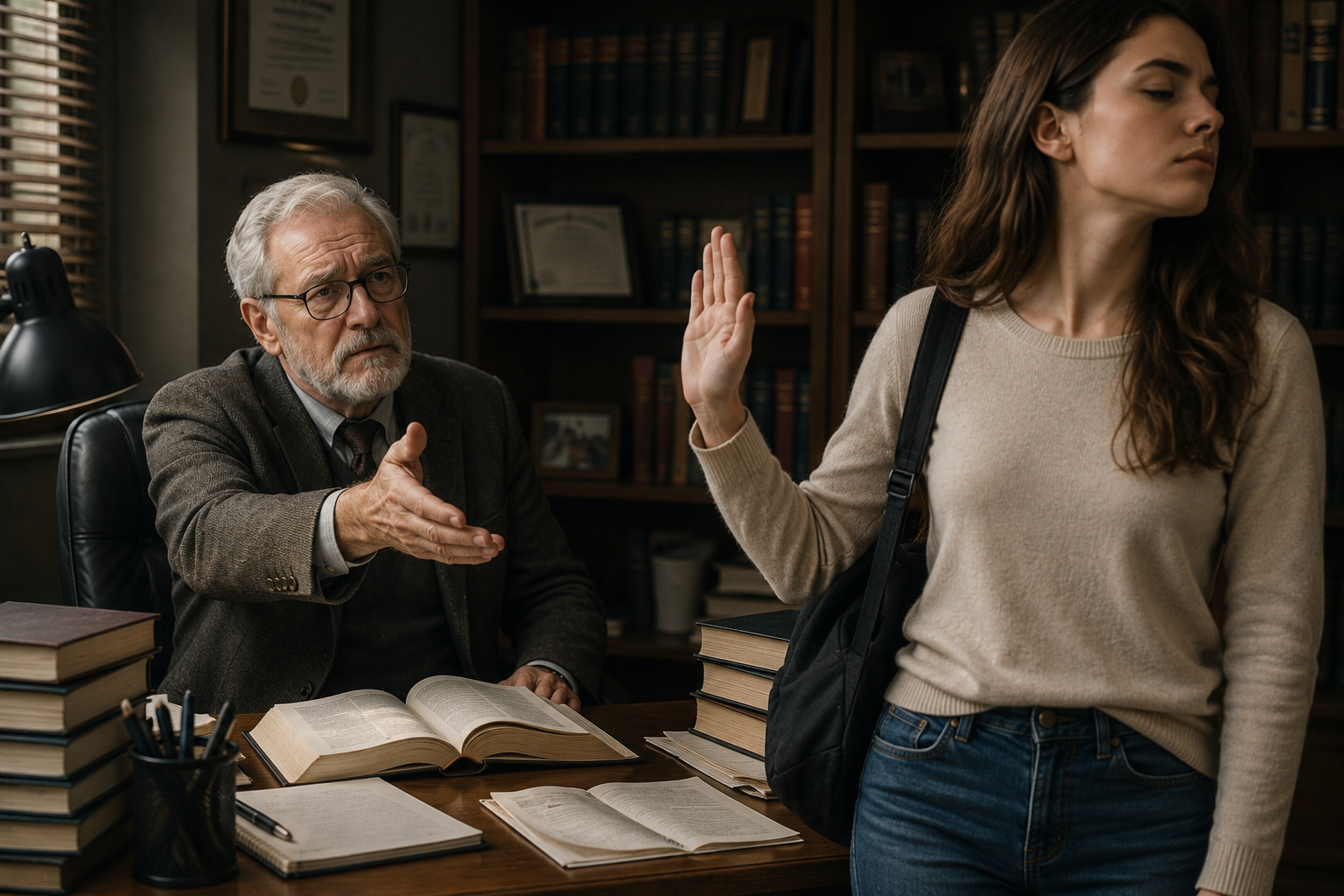
INGRATITUDE: A Scholar’s Forty-One Years of Observation
Life does more than provide knowledge. Without our realizing it, it also introduces us to people, teaches us how to recognize character, and offers lessons that are never found in books. Looking back, I can see that some individuals taught me more through a single action than dozens of books ever could. I have come to believe that a person’s true education is completed not in classrooms, but through relationships, disappointments, quiet observations, and experiences refined by the passage of time.
I first stepped into academia in October 1983 as a young research assistant. A long journey lay ahead of me, and my ideals were lofty. I saw the university not merely as a place where knowledge was created, but as a community where honesty, hard work, and loyalty were respected and rewarded. At that age, one naturally believes that good intentions will be met with appreciation.
Forty-one years have passed since then.
During those years, I met thousands of students, shared hallways and offices with hundreds of academics, and worked under many different administrators. I witnessed both achievements and disappointments. Friendships were formed, rivalries emerged, some people proved far more admirable than I had hoped, while others became disappointments beyond anything I had expected.
On the day I retired, in September 2024, I packed my office, carefully taking my books from the shelves one by one. At one point, I paused and looked around. It suddenly occurred to me that I was leaving behind far more than books. The real weight I carried was the countless stories of people that had accumulated in my mind.
I asked myself a simple question:
“What has been the most important lesson these many years have taught me?”
The answer came almost immediately.
Learning science is difficult. Understanding people is even more difficult.
I am not writing these lines to settle old scores. Nor do I intend to judge anyone or revive past disappointments. As we grow older, we begin to feel a different kind of responsibility:
To leave behind what life has taught us for those who come after us.
That is what I hope to do for my children, my grandchildren, and the young scholars who are just beginning their academic journeys. Experience simply grows old when it remains untold. When shared, it can illuminate someone else’s path.
Unfortunately, the first lesson in that legacy is ingratitude.
I have been fortunate to know many grateful people throughout my life. Even today, there are friends whose names still warm my heart whenever I remember them. They never forgot to express thanks, even years later, and they carried every kindness they received in their hearts. Because of them, I have never completely lost my faith in humanity.
But I also encountered ungrateful people.
They taught me an important truth:
Intelligence and character are not the same. Academic titles are no guarantee of humanity.
Over the years, I noticed that they often shared strikingly similar traits.
First and foremost, the memory of kindness is remarkably short. Years of support, sacrifice, and sincere effort can disappear from their minds almost overnight. Yet the one thing you were unable to do for them is remembered forever. It is astonishing how dozens of acts of kindness can become invisible in the face of a single unmet expectation.
Once their need has been fulfilled, the relationship often comes to an end as well. The person who once called you constantly may one day behave as though you had never met. Then you realize that, for some people, friendship lasts only as long as necessity.
Your sacrifices gradually become ordinary. What you once gave freely is no longer seen as generosity, but as something you were simply expected to do. Kindness that goes unacknowledged eventually becomes viewed as an entitlement rather than a gift.
Another common characteristic is their unwillingness to accept responsibility. When things go wrong, they look everywhere except in the mirror. If someone must be blamed, it is often the very person who supported them the most. Recognizing one’s own shortcomings requires courage. Blaming others is always easier.
You stand beside them in their darkest moments. You give your time, your effort, and sometimes even your peace of mind. Eventually, life improves for them. Then, one day, you discover that you are the first person they have forgotten. The feeling this leaves behind is not so much bitterness as astonishment.
Perhaps the saddest part is this:
They mistake your kindness for weakness. They take advantage of your sincerity, accept your help as something they deserve, and may even hold you responsible for the difficulties they later encounter.
At that point, you realize that ingratitude is more than simply forgetting a kindness. Sometimes, it becomes an attempt to diminish the very person who offered that kindness.
After forty-one years, I have reached one conclusion:
Ingratitude is not forgetfulness. It is a matter of character.
Everyone forgets from time to time. Human memory is imperfect. But grateful people never forget the hand that was extended to them. Even after many years, they know how to say a simple “thank you.” Sometimes a single sentence is enough to erase the weariness of many years.
Ungrateful people, however, often leave behind nothing but disappointment. They build relationships not from the heart, but from calculations of personal benefit. And when those calculations change, the relationship changes with them.
Today, there are a few things I wish to say to my children, my grandchildren, and everyone reading these words.
Never stop trusting people.
Never stop doing good.
Do not allow the shortcomings of others to change your own character.
But give yourself time before placing complete trust in anyone. A person’s true character is revealed not by what they say, but by how they behave when their interests change.
The greatest wealth in life is not knowledge.
Nor is it money.
As for status, it is merely a borrowed title that one day will be left behind.
True wealth lies in meeting the right people along life’s journey and remaining in their memories as a good person many years later.
Academia taught me countless scientific truths. Yet perhaps its most valuable lesson was one that could never be found in any textbook:
You can learn knowledge by reading. You can understand people only by living among them.
And if I were to leave behind only one piece of advice from my forty-one-year academic career, it would be this:
Do good. But choose carefully the people to whom you entrust your kindness. Gratitude elevates a person. Ingratitude quietly erodes first one’s character, and then one’s relationships.